The violet roofline has quietly replaced the inflatable ghost as the most common Halloween exterior in North American suburbs. The hardware behind it is an extruded aluminum channel with an LED strip inside - and the engineering is the reason it looks the way it does.A Saturday Halloween, and a more disciplined look
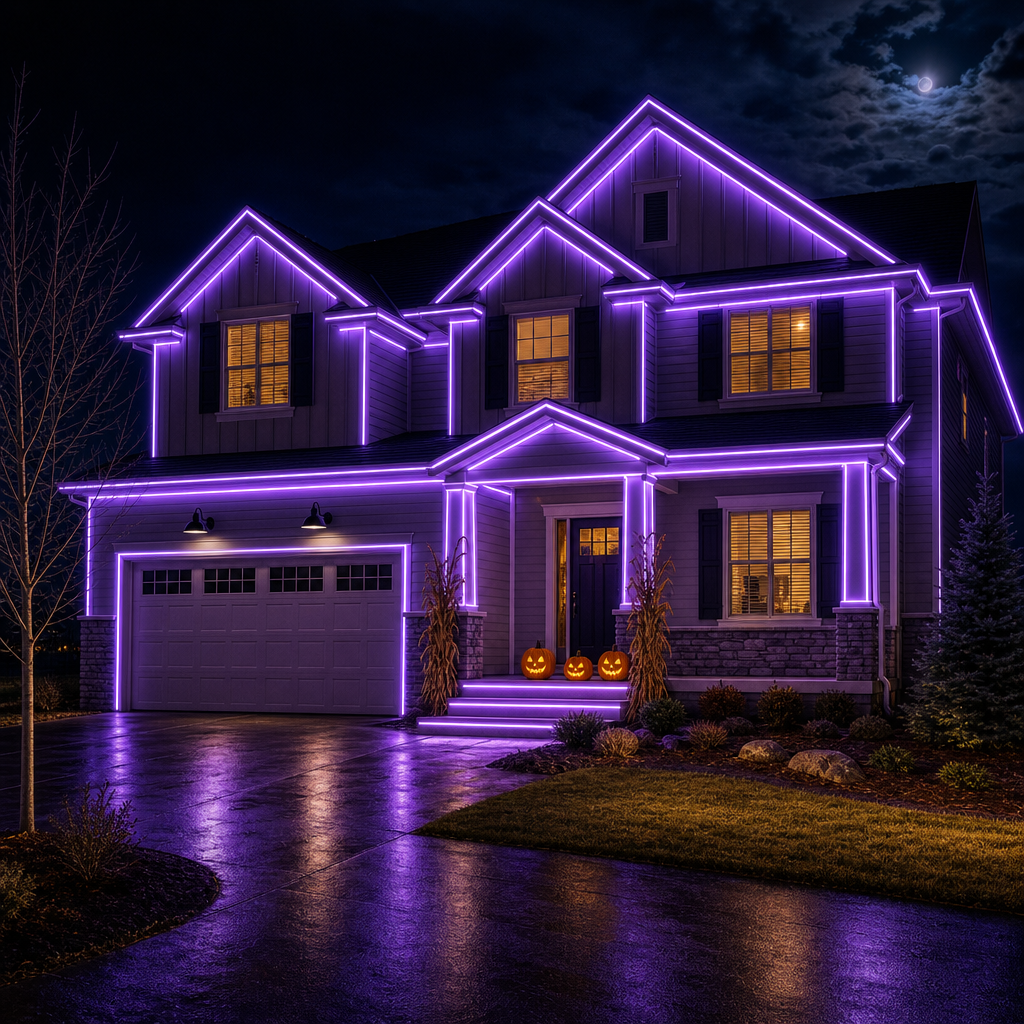
Halloween falls on Saturday, October 31 this year. What separates this season is not the volume of decoration but the lighting language: the dominant exterior look has shifted from soft, scattered glow toward a hard-edged continuous line - violet light tracing the fascia, wrapping the gable end, folding around the porch corner and stopping cleanly at the garage. From the street it reads less like decoration and more like a drawing of the house.
That precision is a hardware decision rather than a taste decision. The line is produced by an aluminum LED channel - an extruded metal profile with a diffuser cover and an LED strip mounted inside - and not by a string of bulbs clipped to the siding.
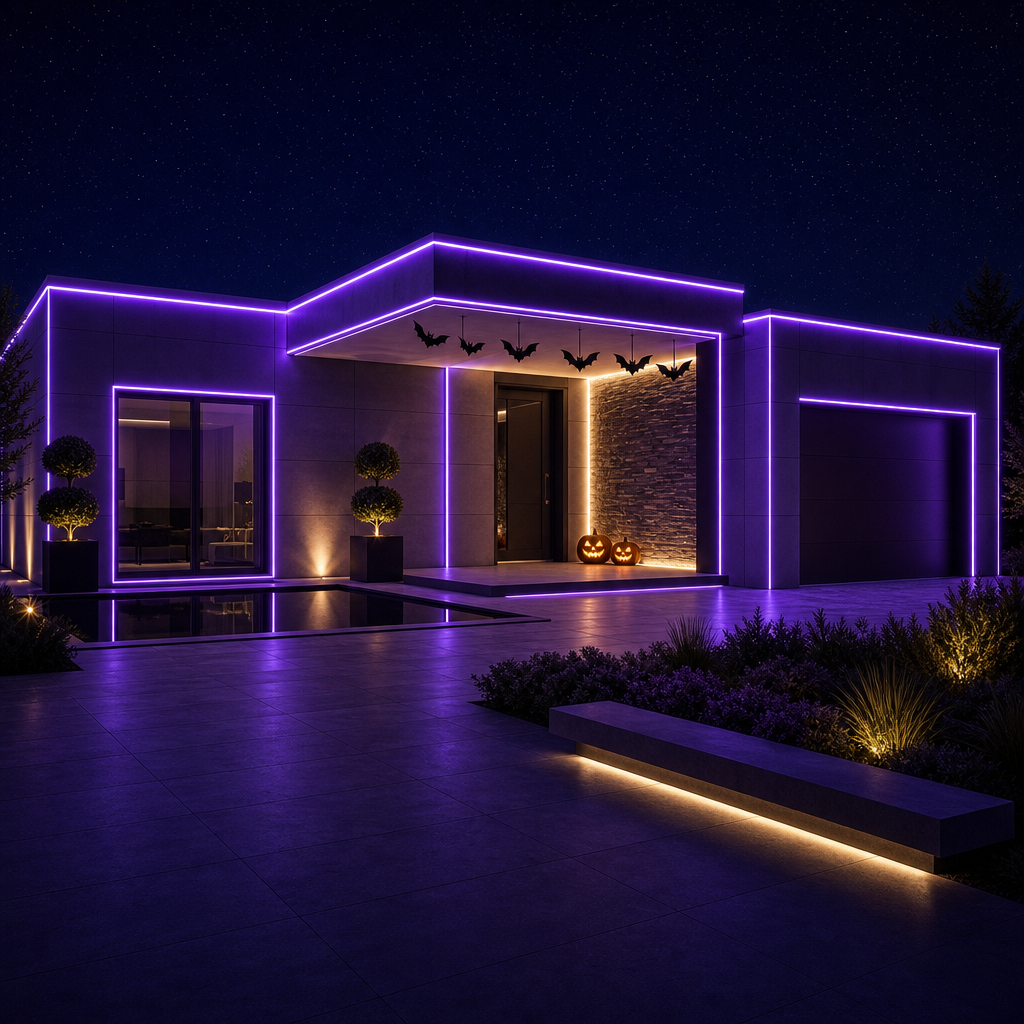
At a distance, a bare LED strip and a strip inside a channel can look similar. At the distances that matter - the driveway, the walkway, the porch step - they do not. A bare strip shows its diodes: individual emitters read as bright dots, and the pitch between them is visible as a scalloped, uneven light. An aluminum profile with an opal polycarbonate diffuser mixes that light across the width of the extrusion and produces one uniform bar with no resolvable source points. For a run meant to trace an architectural line, that is the difference between a light strip and a drawn line.
Mounting is the second difference. A bare strip is held by its own adhesive backing, which sees summer heat, winter freeze-thaw and the thermal cycling of the strip switching on and off. A channel is fastened with clips or screws into the substrate and carries the strip inside a rigid body, so the installation does not depend on adhesive performance. The third difference is thermal, and it shows up later.
An LED aluminum profile is usually described as a housing. Functionally it is a heat sink. The standard material is 6063-T5 aluminum, an alloy chosen because it extrudes cleanly into the thin-walled U, V, recessed and wide sections that architectural runs require, while still carrying enough cross-section to conduct heat away from the diode junction.
LED output and lifetime both fall as junction temperature rises. A strip bonded to a wooden fascia has almost no path for heat to escape, because the substrate insulates rather than conducts. The same strip inside an aluminum extrusion transfers heat into the metal body, which presents far more surface area to the night air. Two installations can look identical on the first evening and diverge sharply by the second winter: one is being cooled, the other is being cooked.
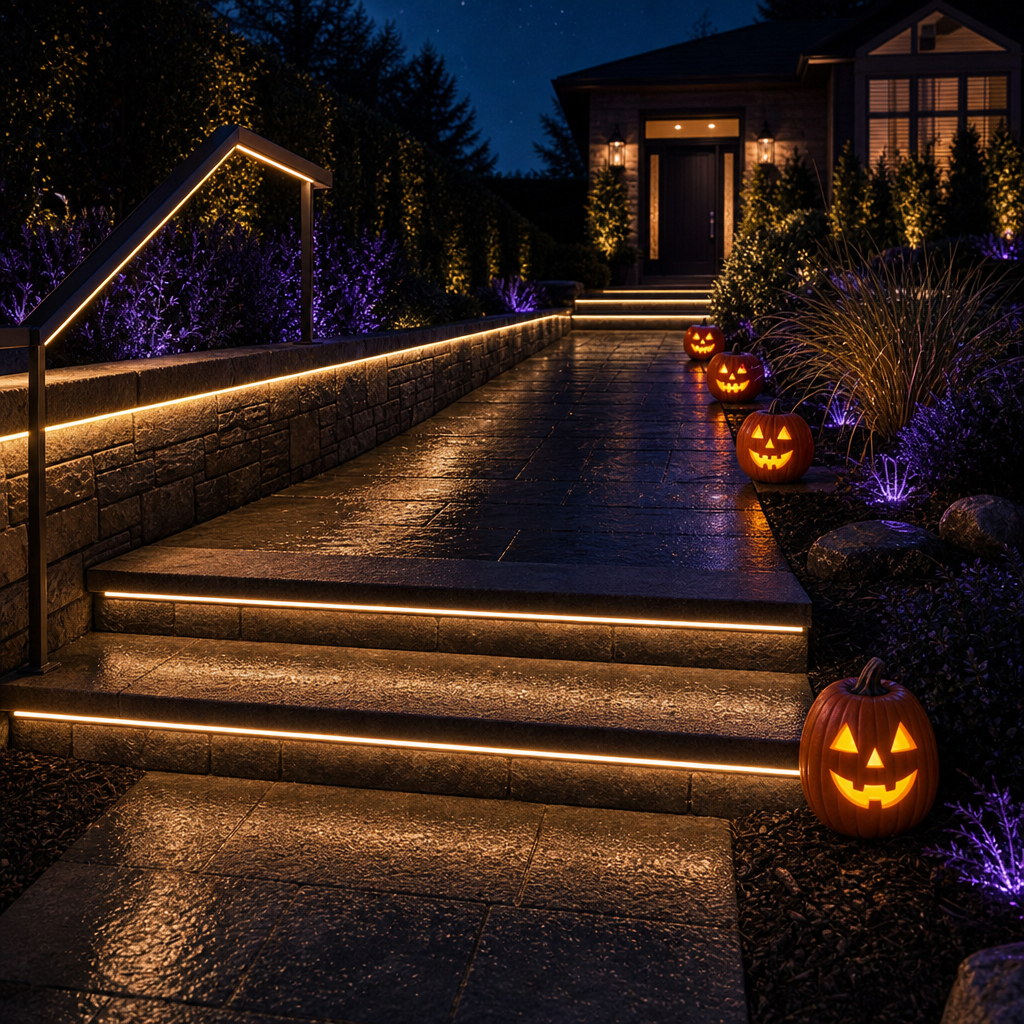
Recessed profiles along step nosings and a wall cap keep the fixture out of sight at eye level - the standard detail for walkways and entries.
Ingress protection becomes the primary constraint outside. An indoor channel is typically IP20, open to dust and incidental contact. An exterior run needs a sealed assembly: a channel designed to accept gaskets, end caps that close the extrusion, and a strip protected by a silicone coating or a fully potted construction. Assembled correctly, an outdoor channel reaches IP65 or IP67. Assembled carelessly, the same hardware collects condensation and fails by moisture tracking along the strip rather than by an obvious break.
Voltage and run length interact on a facade. Exterior runs are long, and a long low-voltage run loses brightness toward its far end as voltage drops along the conductors. A 24V system tolerates roughly twice the run length of a 12V system at the same brightness, which is why 24V has become the default for continuous rooflines. Where one feed cannot cover the geometry, the practical answer is a second feed rather than a supply pushed to its limit.
Water also has to be given somewhere to go. A channel under a soffit or along a fascia will see driven rain, snowmelt and ice. Exterior extrusions are specified with drain provisions, or installed with a slight fall and weep points, so meltwater leaves the profile instead of standing inside it against the strip. Cold changes the mechanics as well: silicone and PVC stiffen as temperatures drop, and clips that gripped well in October can loosen by January, which is an argument for compression-fit covers over adhesive.
The reason one installed run can serve both holidays is that the emitter has become addressable. RGB and RGBW strips let a fixed channel produce deep violet in October and warm white or multi-colour scenes in December with no physical change to the installation. Warm white remains the useful base for everyday curb appeal, and the holiday scenes are overlays on top of it.
This changes the economics of exterior lighting for households that decorate twice a year. Instead of a temporary string bought, hung, tangled and discarded, the channel run is installed once as an architectural line and repurposed seasonally through the controller. For the violet look that has become the shorthand of the season, RGBW output through an opal diffuser gives a saturated, even wash instead of the patchy spill of individually coloured bulbs.
On a flat-roofed elevation the same section is used vertically and horizontally, so parapet, canopy and entry portal read as one continuous outline.
Three profile families cover most of what appears on a decorated facade. Surface-mounted fascia and soffit profiles are the workhorses: slim sections that sit flat against the substrate and turn a roofline into a continuous line.
V-shaped and corner profiles solve the hard problem in any exterior run, the 90-degree change of direction. A straight channel cannot follow the corner of a gable end or a porch return without leaving a visible break or an over-bent strip, so a V section is designed to be mitred or formed at that point.
Recessed profiles are set into the surface so only the glow remains visible, the standard choice for step nosings, wall caps and path edges, while wide and deep sections handle higher output and longer runs.
Whether the run is specified for a single Halloween or a permanent installation, the same short list applies. Confirm the alloy and finish: 6063-T5 with an anodized or powder-coated surface resists corrosion and holds colour, while unfinished aluminum oxidizes. Confirm the diffuser, since opal polycarbonate is the exterior standard. Confirm that gaskets and end caps are supplied as part of the system, because a profile sold without them is not an outdoor solution. Confirm the electrical listing, use a listed low-voltage supply on a protected circuit as local code requires, and confirm the accessories - cut increments, connecting pins, corner connectors, clips and drain details - because those decide whether the finished line is continuous or shows a joint every metre.
The appeal of the violet roofline is that it looks deliberate, and none of that impression is accidental. It comes from an extrusion that holds a straight, unbroken geometry, a diffuser that removes the dots, and a thermal design that keeps the output stable past the first season. When the calendar moves from Halloween into Christmas, the same channel run will be asked to do it again in a different colour.
 Hot News
 EN