
Key Specifications of Support Trolleys for Buyers

Get a Free Quote

Our representative will contact you soon.
Email
Mobile/WhatsApp
Name
Company Name
Message
0/1000

support trolley

Support  trolleys  are essential components in  various  industrial applications,  providing the stability and mobility needed to transport materials and tools efficiently.  For B2B buyers, understanding the specifications and applications of support  trolleys  is  crucial for ensuring the right  fit for their projects. This article will  guide you  through key  specifications, selection criteria, installation  considerations, and  various industrial  applications,  helping you  make  informed purchasing  decisions.

How to Choose the Right Support Trolley for Your Project Needs

Selecting the right support  trolley requires  a comprehensive understanding of your project's unique requirements.  Here are  some factors to consider:

Application Requirements: Determine the specific tasks the trolley will perform. For instance,  a trolley used  in a warehouse for transporting heavy equipment  will have different specifications than one used in a retail  environment for moving  lightweight goods.

Environmental Conditions: The working environment will influence  material selection. For outdoor use or in humid environments, corrosion-resistant materials like  aluminum or galvanized steel are preferable to  ensure longevity. For outdoor applications, consider our HDG Cable Ladder for added durability.

Budget Considerations: While it may be tempting to  choose the least expensive option, consider  the total cost of ownership, including maintenance, potential  replacements, and the trolley's lifespan. Investing in a  higher-quality trolley may yield better long-term value.

Supplier Reputation: Seek suppliers with a  solid reputation for quality and reliability. Look for manufacturers like Shanghai Qinkai Industry Co., Ltd., who have proven experience  in the industry and  can offer certifications that assure product  quality.
What to Look For

When  evaluating  potential suppliers and their support trolleys, consider the following:

Certifications and Compliance: Ensure the products comply with relevant industry standards, which can  vary based on application and  region. Certifications can provide assurance  regarding safety and quality.

Quality  Control Processes: Inquire  about the manufacturer’s quality assurance processes. A reputable supplier should have  a robust  quality control system to ensure consistency and reliability in their products.

Customer Support: Assess the  level of support offered by the  manufacturer, including pre-sales advice, post-sale service,  and  warranty options. Strong customer support can enhance  the purchasing experience and provide assistance if issues  arise.

Real-World Testing:  Request information on how the trolleys are tested before shipment. Real-world testing under actual operating conditions  can reveal performance characteristics  that specifications alone cannot.

Common Installation Issues with Support Trolleys and Their Solutions

While installing support trolleys may seem straightforward, several common  issues can arise:

Alignment Problems: Misalignment during installation  can lead to uneven weight distribution,  causing  premature wear or failure. Ensure  that the trolley is level and properly aligned before securing any bolts or fixtures.

Incompatibility with Existing Equipment: Some trolleys may not  fit well with existing systems or machinery. Buyers should  measure and confirm compatibility with other equipment to avoid operational disruptions.

Load  Distribution: Improper loading can  lead to instability.  Buyers  should be advised on proper  loading techniques,  starting with lighter items  at  the top and heavier items at the bottom, to maintain a low center of gravity.

Surface Conditions: If the surface is uneven or slippery, the  trolley may not operate  effectively.  Consider adding non-slip pads or using trolleys with larger wheels designed for rough terrain to enhance stability.

Applications of Support Trolleys in Various Industrial Settings

Support trolleys are versatile tools utilized across multiple industries, including:

Manufacturing: In  manufacturing plants, support trolleys facilitate the movement  of raw materials to  production lines, enhancing workflow efficiency.

Warehousing and Distribution:  Trolleys help organize and transport products within warehouses, making it easier to manage inventory and fulfill orders quickly.

Healthcare: Hospitals and clinics use support trolleys  to transport medical supplies  and equipment, ensuring that items are readily available where needed.

Construction: In construction sites, trolleys are employed to move  tools  and materials, improving site organization and reducing the risk of accidents.

Retail: Retail environments  use trolleys for restocking shelves and  displaying products, providing a practical solution for managing merchandise efficiently.

By understanding these applications, buyers can make  informed decisions  about the types of support trolleys that best  meet their operational needs.

In summary, choosing the right support trolley  involves careful consideration of specifications, project requirements, and supplier capabilities. By focusing on  these  key areas, B2B buyers can ensure they select a solution  that  enhances operational efficiency  and meets their specific needs.

Understanding the Key Specifications of Support Trolleys for Wholesale Buyers

When evaluating support trolleys, several  key specifications must be considered:

Load Capacity: This is  a critical measure indicating how much weight the trolley can safely carry. Buyers should assess the typical loads in their operations to ensure the selected trolley  can handle the maximum weight without compromising safety and  performance.

Material Composition: Support trolleys are typically constructed from steel or aluminum. Steel trolleys offer higher  strength and durability, making them suitable for heavy-duty applications, while aluminum trolleys are lighter  and more resistant  to corrosion, suitable for environments where weight reduction is critical. For more robust solutions, consider our SS316 Wire Mesh Cable Tray, designed for durability in harsh conditions.

Dimensions: The size of the trolley, including height, width, and length, affects its maneuverability and compatibility with existing equipment. Buyers  should  measure their workspace to  ensure the trolley fits comfortably without obstructing operations.

Wheels and Mobility: The type and size of wheels can significantly impact the trolley's  maneuverability. Larger wheels tend to perform better on uneven surfaces, while smaller wheels may be more  suitable for smooth floors. Consideration of wheel material is also essential, as rubber wheels offer  better grip and shock absorption.

Customization Options: Many  manufacturers, including Shanghai Qinkai Industry  Co., Ltd., offer customization options for support trolleys. Buyers should inquire about available features, such as adjustable heights, additional shelving, or specialized attachments, to meet  specific operational needs.

Frequently Asked Questions

What is the support trolley used for?

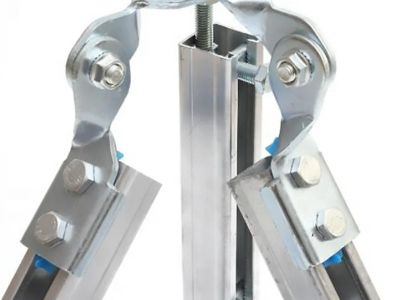
The support trolley provides mobile support for cable trays, piping, solar racking and other equipment during installation, maintenance, and transport within industrial sites.
Our trolleys are made from high-quality steel with protective coatings to resist corrosion and meet structural strength requirements for industrial use.
Yes. The trolley is designed to mount and align with our cable trays, C-channel supports and finished support systems for seamless installation.
We provide customization for dimensions, mounting features and load ratings to match project specs, including heavier-duty designs for seismic or solar applications.
Lead times depend on quantity and customization; typical production ranges from 2–6 weeks. We arrange export packaging and shipping options per customer requirements.

Our Blog Posts

Complete Hardware Glossary: Solar Mounting, Pipe Supports and Cable Management Parts

21

Sep

Complete Hardware Glossary: Solar Mounting, Pipe Supports and Cable Management Parts

Understanding the components of solar mounting structures, pipe supports, and cable management parts is crucial for professionals in the manufacturing and construction industries. This complete hardware glossary will provide insights into evaluating ...
View More

Get a Free Quote

Our representative will contact you soon.
Email
Mobile/WhatsApp
Name
Company Name
Message
0/1000

Related product categories

Key Specifications of Support Trolleys for Buyers

Get a Free Quote

Our representative will contact you soon.
Email
Mobile/WhatsApp
Name
Company Name
Message
0/1000